

Your quote
–
The same job at other terms
| Term | Fee range |
|---|
Every quote tracked. Every insight surfaced.
Save a quote and it lands here. The dashboard totals what you have booked, flags the money still owed to you, and shows where your work is coming from.
- See what you have booked, this month and all time
- Track every quote you have out, so nothing slips
- Know which clients are worth chasing and which went quiet
- Watch your win rate and average booking climb
- Every quote saved, searchable, and exportable
Your voiceover numbers, easy to read!
Insights reads everything about your quotes and helps you understand trends over time. How is your month going? Who is worth chasing? And where is the work really coming from?
- See how the month is going in one sentence
- Know which client is worth your time
- Get told which quotes are worth a follow up
- Watch your earnings grow month over month
- Save any chart as an image for your records
You are at $4,300 booked, with $7,700 still sitting in your pipeline.
Halcyon Media is your best client, with 8 jobs and $6,900 booked.
Two quotes have gone quiet for over a week. A nudge closes far more of them.
Dashboard
More numbers
Monthly target
Worth chasing
Top clients
By booked work, all time.Booked, by month
View as table
Where the work is
Saved quotes
Nothing here yet. Build a quote and hit Save.
Trash (0)
Deleted quotes wait here until you empty them.
Hello.
What it does
Real rates, not vibes
Every number comes from a compilation of respected current industry rates, kept current. You get a number range to negotiate confidently.
Never bill a right twice
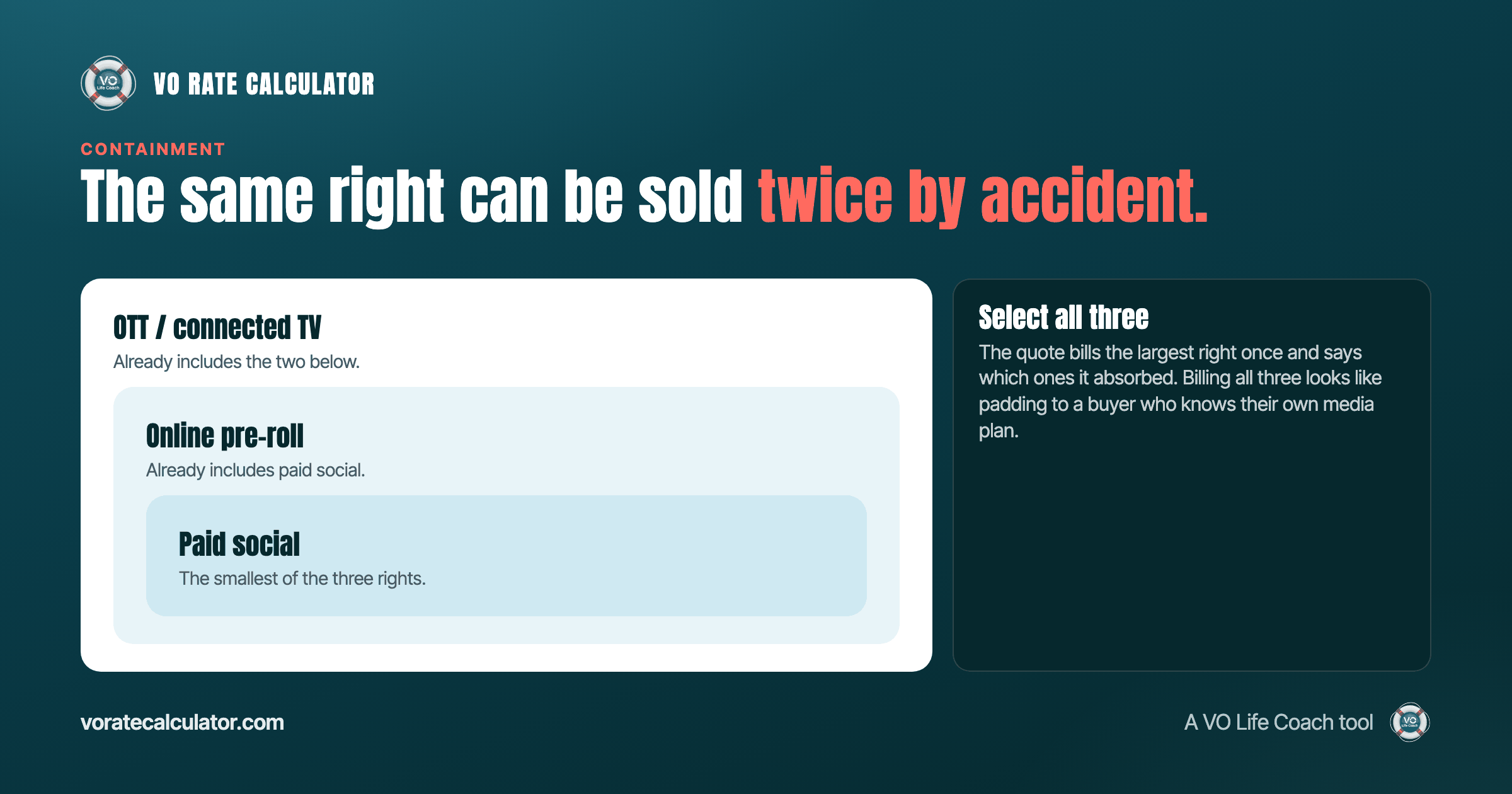
OTT already includes pre‑roll and paid social. Select all three and the quote bills once, and tells the client why.
Union math, handled
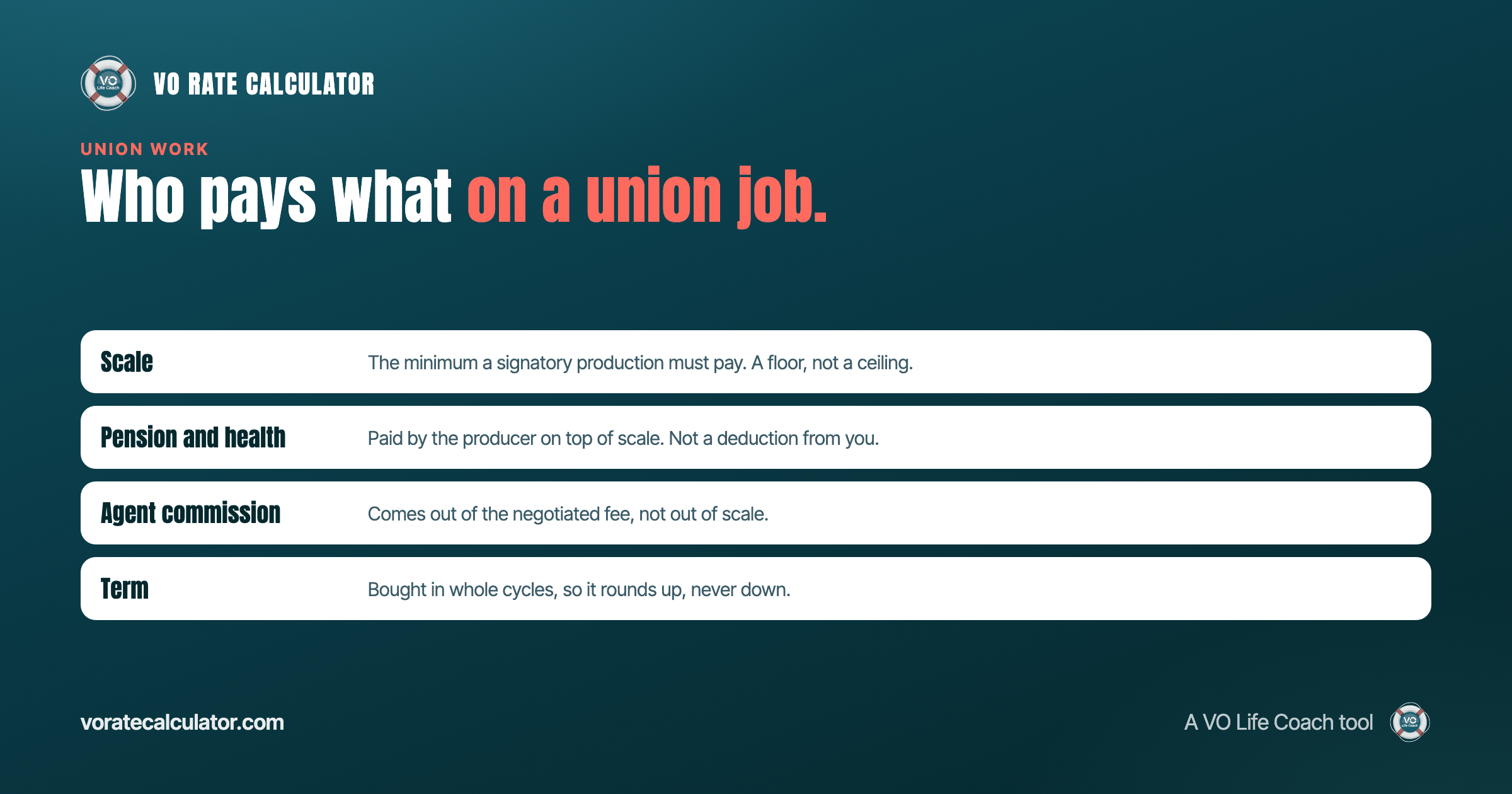
Whole‑cycle rounding, pension & health on top for the producer, agent commission out of scale. Who pays what, spelled out, against the current union scale.
What sets a voice over rate
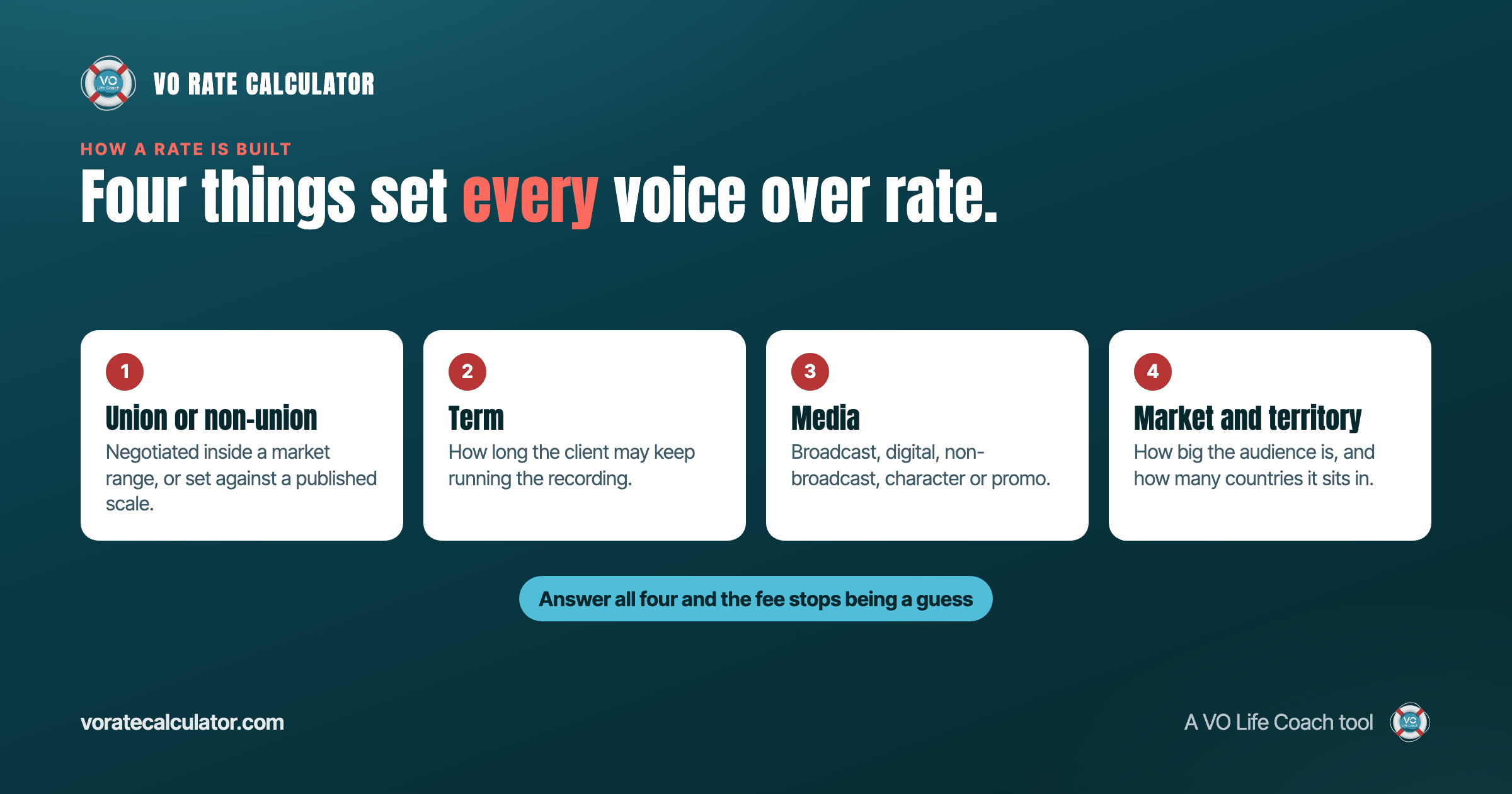
Every voice over quote is built from four things, and this voiceover rate calculator asks for them in the order a client usually gives them. Union or non‑union decides whether the fee is negotiated inside a market range or set against a published scale. Term is how long the client may keep running the recording. Media is where it runs: broadcast, digital, non‑broadcast, character or promo. Exclusivity is what you agree not to do for anyone else while the job is live, and it is the term most often left out of a quote that later turns out to have been underpriced.
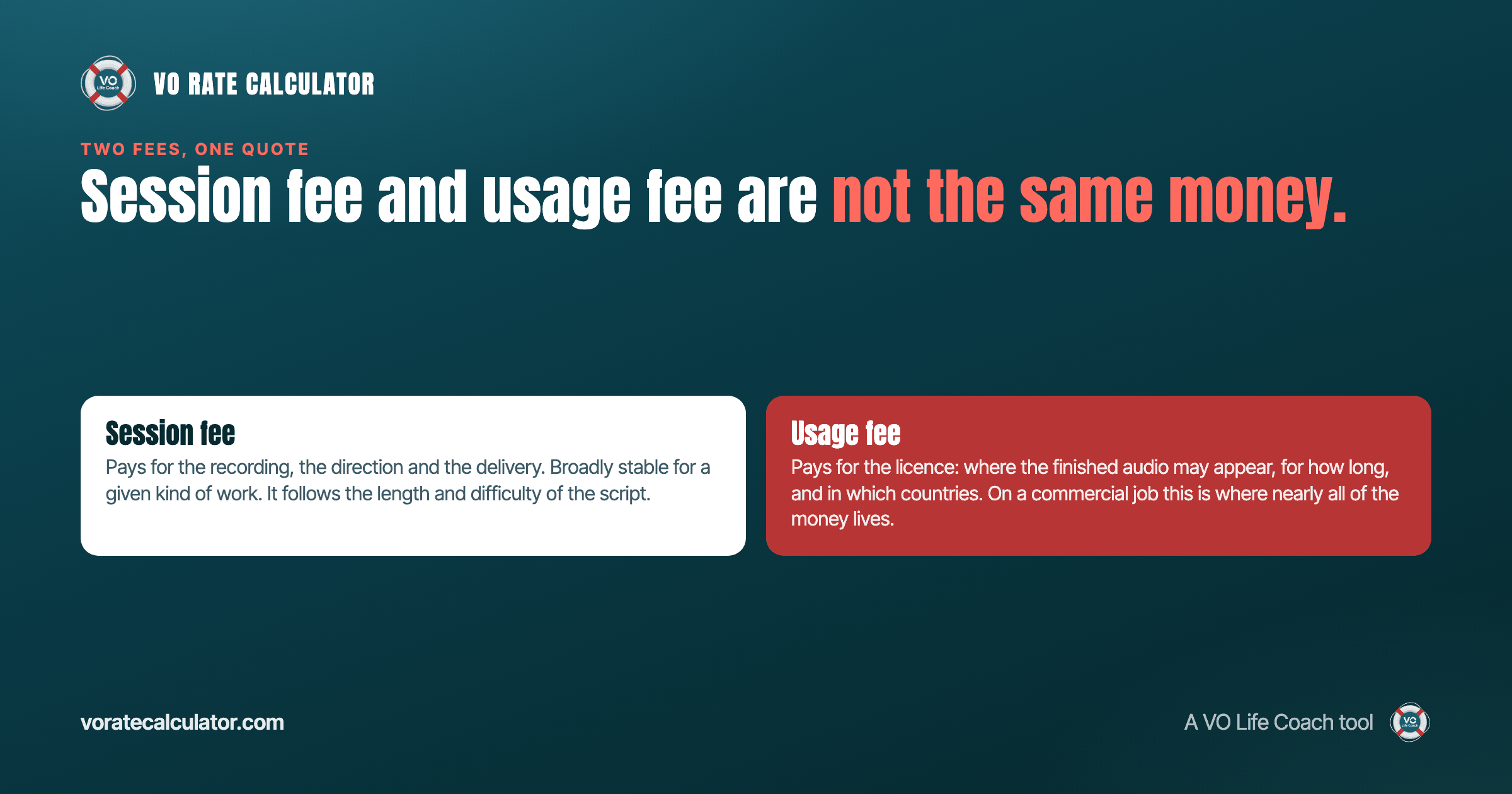
Session fee and usage fee are not the same money
A voice over fee is not one number. The session fee covers the recording, the direction and the delivery, and it is broadly stable for a given category of work. The usage fee covers where the finished audio is allowed to appear and for how long, and on a commercial job that is where nearly all of the money lives. A thirty second read that takes twenty minutes to record can be worth many times its session fee once national usage is attached to it. Quote the session, give the usage away, and you have done the work for a fraction of what it was worth.
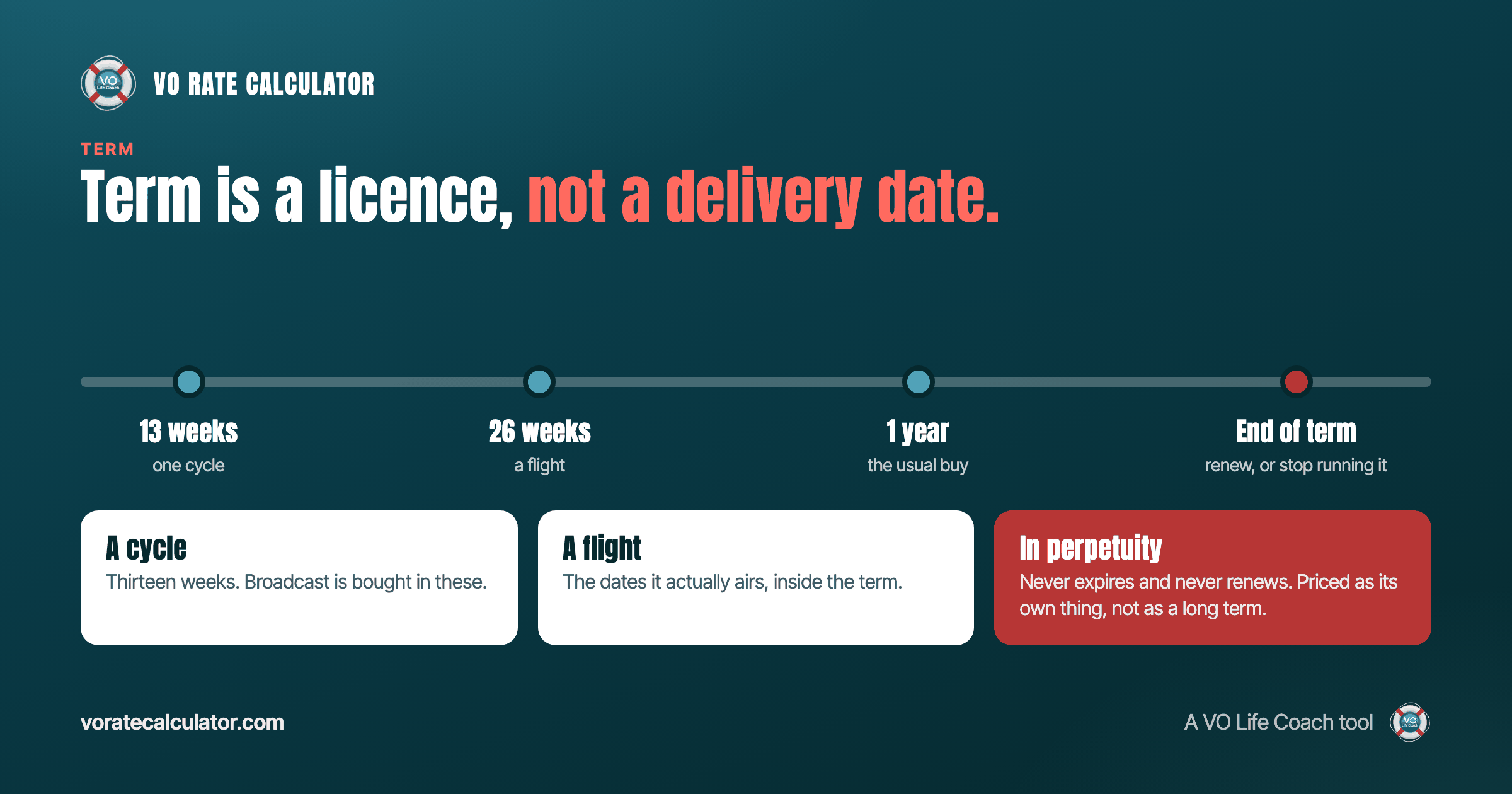
Term is a licence, not a delivery date
Term is the window the client has bought. A thirteen week cycle, a six month flight and a one year buyout are three different products, and the end of the term is the point at which the client either stops running the work or pays you again. When a client asks for perpetuity they are asking for a licence that never expires and never renews, so it has to be priced as its own thing rather than as a long term.
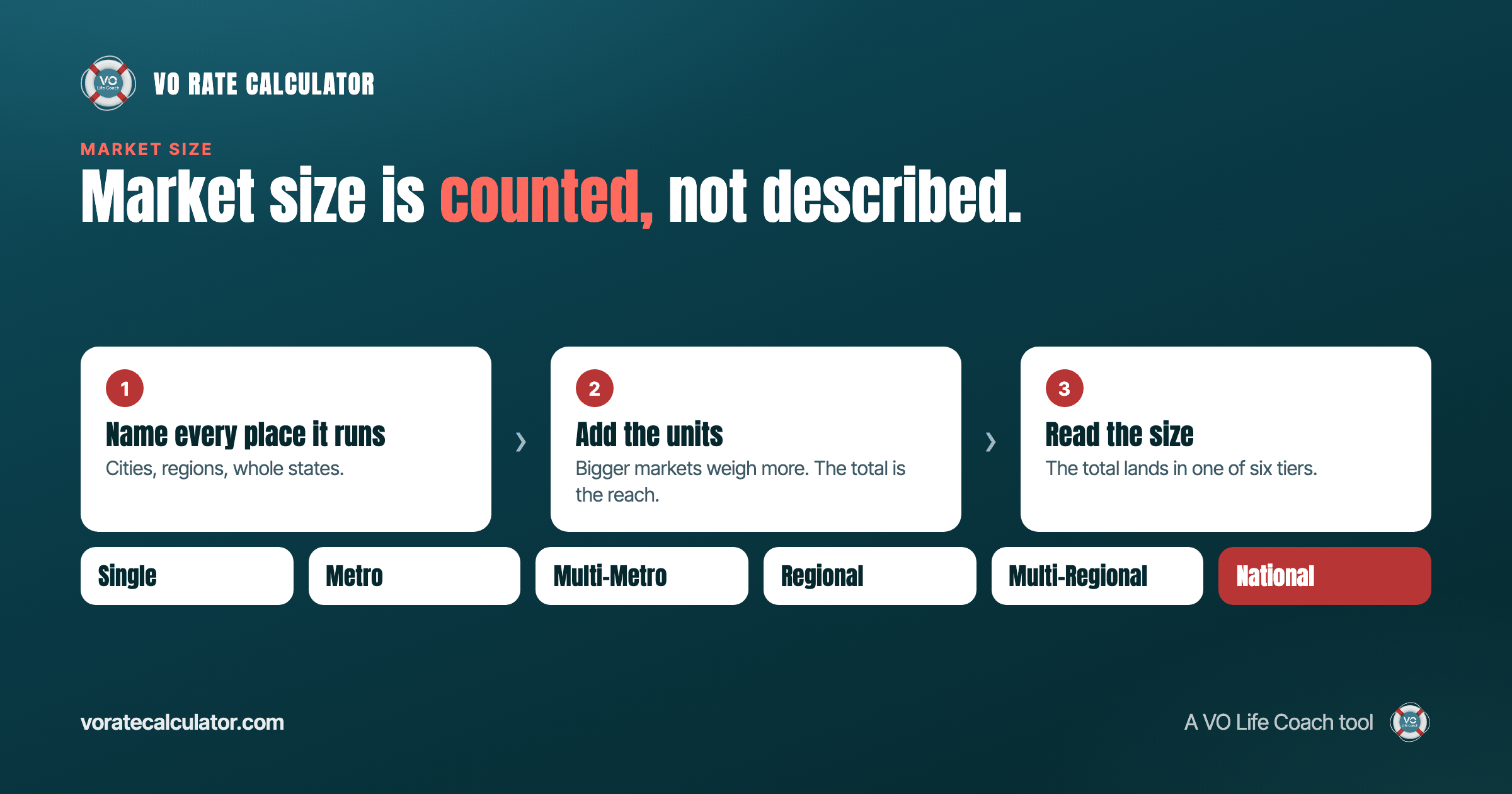
Market size is counted, not described
Broadcast usage is priced by reach. Cities, regions and whole states are counted in units, and the total decides whether a job is a single market buy, a metro buy or a national one. This matters because clients often describe a job as local while listing enough markets to add up to something much bigger. Adding the reach up before you quote is the check that catches it.
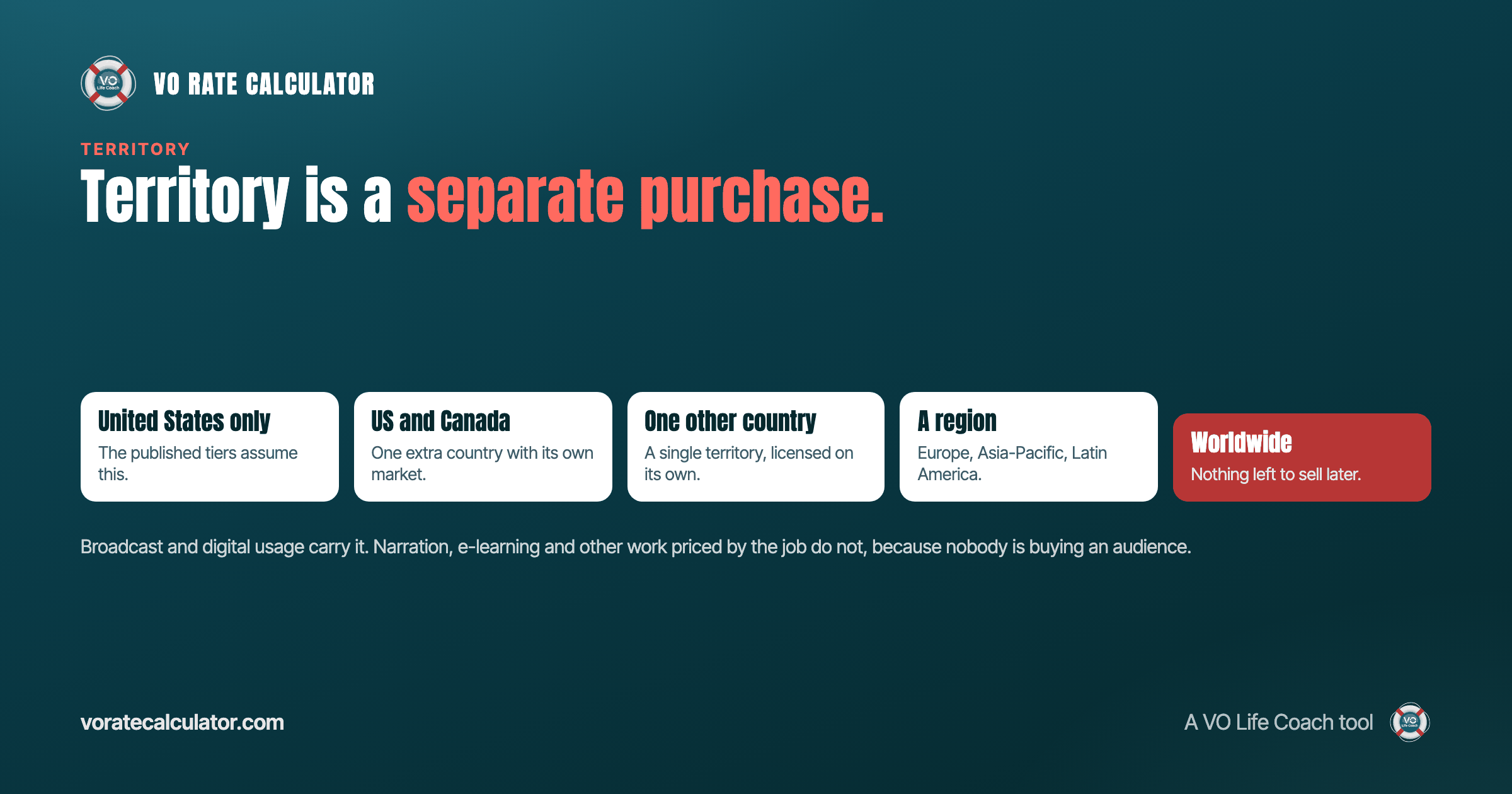
Territory is a separate purchase
Market size counts the audience inside one country. Territory is how many countries the licence covers, and it moves the fee on its own. A national buy in the United States, the same buy across the United States and Canada, and a worldwide buy are three different products from one session. The calculator asks for the territory once a broadcast or digital usage is on the quote and prices the difference as its own line, so the client can see what the extra countries cost. Narration, e‑learning and other work priced by the job do not carry it, because nobody is buying an audience.
The same right can be sold twice by accident
Media categories overlap. Connected television, pre-roll and paid social are not always three separate rights, and depending on how the buy is structured one of them can already contain the others. Billing all three looks like padding to a buyer who knows their own media plan, and the credibility costs more than the line item was worth.
Union scale is a floor, not a ceiling
Scale is the minimum a signatory production is required to pay. Pension and health contributions sit on top of it and are the producer's obligation rather than a deduction from you, agent commission comes out of the negotiated fee rather than out of scale, and the term rounds in whole cycles. Knowing which of those move in your favour is the difference between accepting a number and negotiating one.
Non‑union work is a range, and the range is the point
Outside a union agreement there is no single correct figure, only the band that comparable work usually pays. Your job is to decide where inside that band your quote lands, using turnaround, experience, exclusivity and what the client is buying elsewhere as the levers. A range tells you how much room you have before you are underselling, which a single number never does.
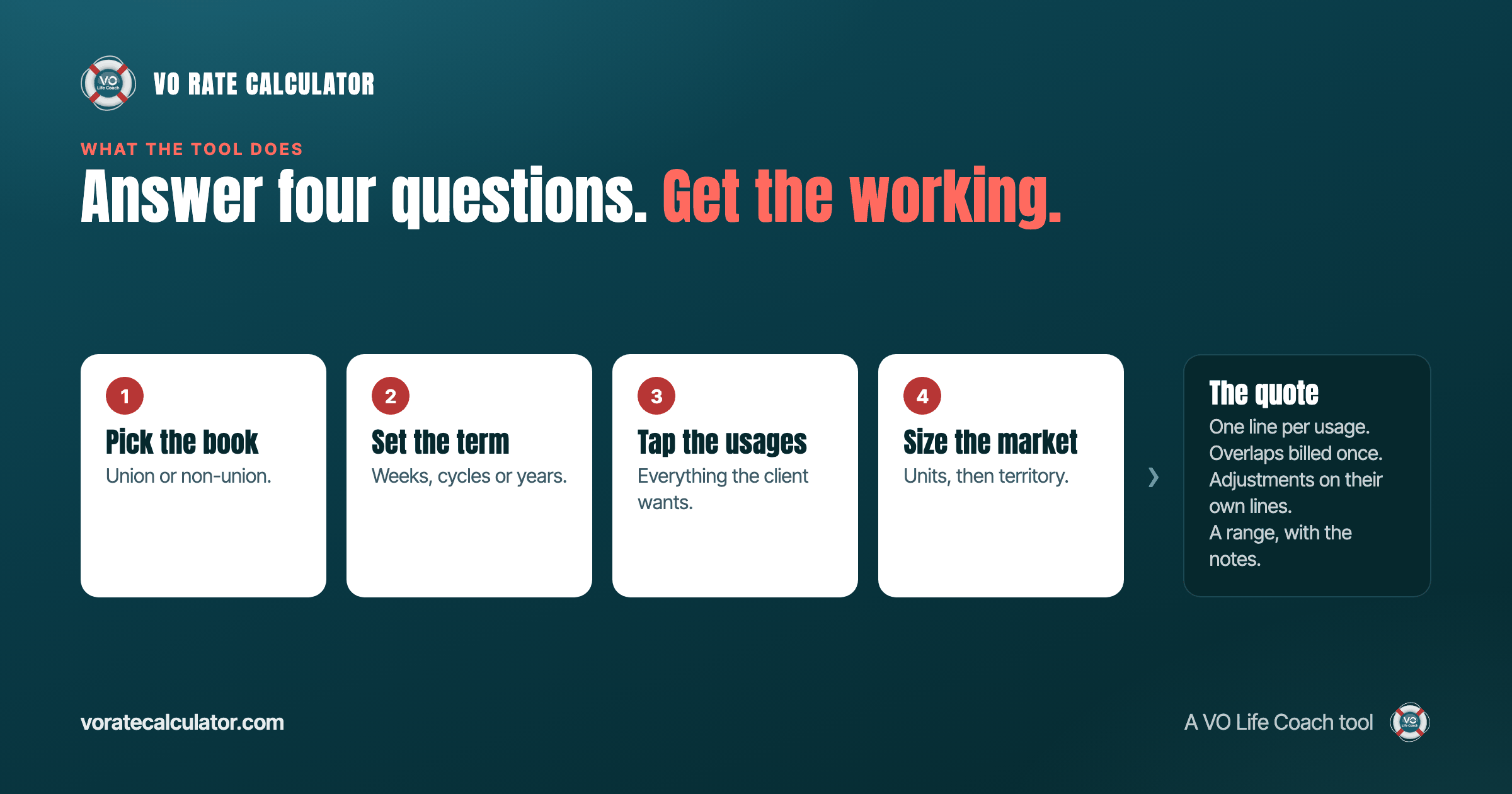
What the calculator does with all of that
You answer four questions: union or non‑union, how long it runs, where it runs, and how big the market is. It applies the rules for the category you picked, resolves the overlaps so no right is billed twice, does the union arithmetic where it applies, and returns a quote range with notes explaining every step it took, so you can hand a client the reasoning and not just the number. Rates are compiled from public and private industry sources and fine tuned with input from working industry experts. Your first three quotes are free.
If you would rather read than click: how voiceover rates are built covers the four inputs in full, usage and buyouts explains what a licence actually buys, union and non‑union work compares the two rate books, what a voice over job costs walks a brief through to a number, and the glossary defines the words clients use in a brief.
Unlimited quotes and insights
The full calculator, every quote saved to your account, exports, and the dashboard that tracks what you have booked. Cancel anytime.
VO Life Coach app subscribers have access for free. Check out the VO Life Coach app here.